

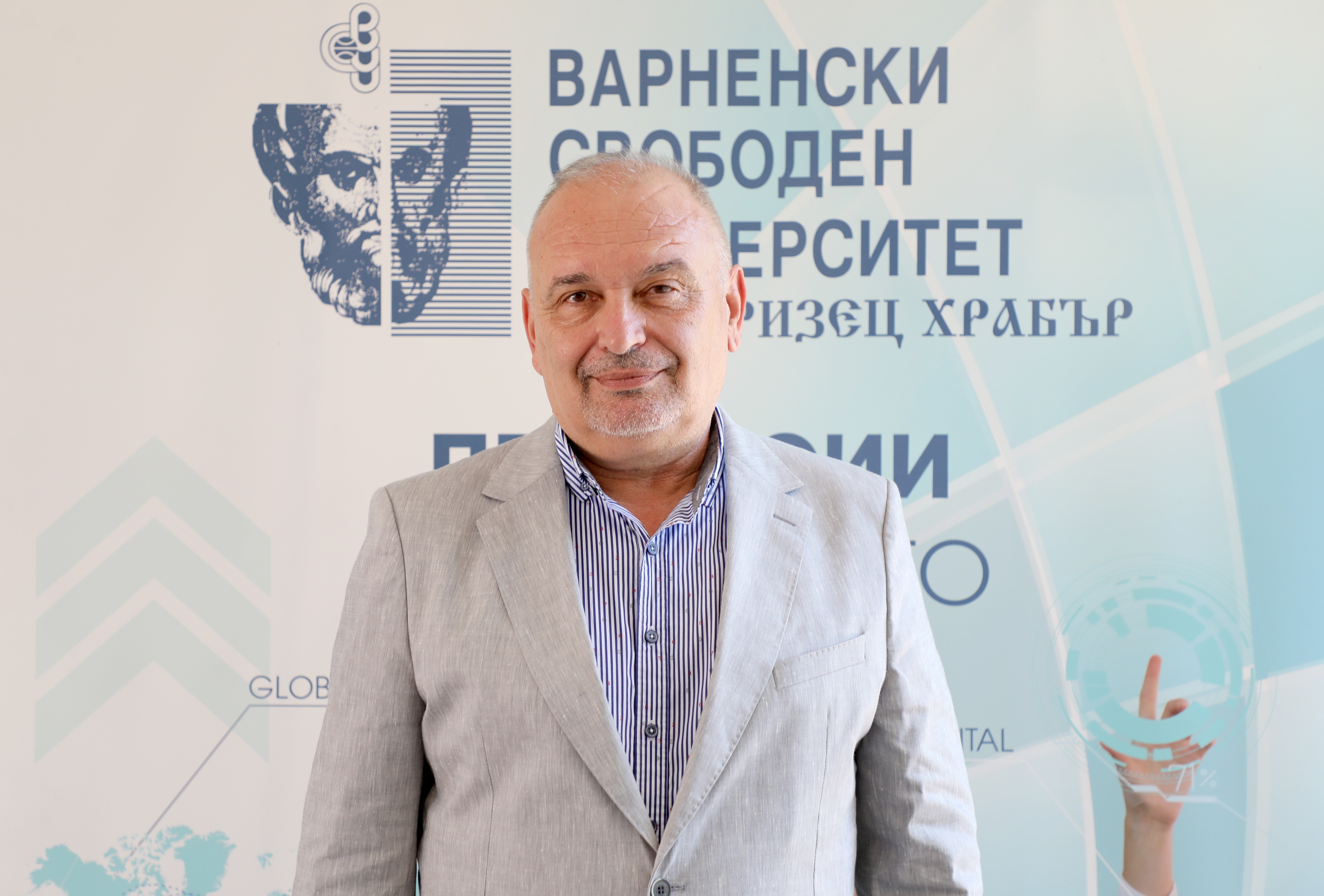
By 2029, Varna Free University will become a model of a higher education institution in applied sciences, Rector Prof. Petar Hristov told Bulgarian News Agency.
18 may 2026
BTA correspondent in Varna: Mila Edreva
Varna, 18 May 2026, 09:01 (BTA)
By 2029, Varna Free University “Chernorizets Hrabar” will become a model institution for higher education in applied sciences, said Rector Prof. Dr. Petar Hristov. He recalled that this year the university is celebrating its 35th anniversary, and that later this week more than 400 alumni are expected to attend the largest alumni reunion in the institution’s history.
Prof. Hristov has been a lecturer at the university since 1994. Over the years, he has served successively as Head of the Department of National Security, Dean of the Faculty of Law, and since early 2019, Rector of the university. He established Bulgaria’s first university degree programme outside the specialized state academies dedicated to national security protection. He is the author of more than 100 academic publications and has been invited as a guest lecturer at key universities in Poland, Croatia, Ukraine, Russia, Turkey, Cyprus, Serbia, and the United States.
According to Prof. Petar Hristov, Bulgaria has still not achieved genuinely equal treatment between public and private higher education institutions. In his view, although the state has taken important steps in recent years to stabilize the higher education system, private universities continue to operate in a significantly less favorable financial and regulatory environment. Private higher education institutions do not receive state subsidies for education, lack access to various support mechanisms, and are often forced to finance policies with their own resources that are budget-funded in public universities, the Rector of Varna Free University pointed out.
Prof. Hristov also emphasized that there are no differences when it comes to accreditation requirements, compliance with national standards, or public responsibility. Bulgarian society is gradually beginning to understand that the quality of a university does not depend on its ownership model, but on its results - namely the preparation of students, their professional realization, academic research, and the institution’s connection with business and society, he added. According to him, Varna Free University has been proving this for more than three decades. The Rector further stressed that private universities are not seeking privileges, but rather equal rules, predictability, and the opportunity to develop their potential in a competitive environment.
Prof. Hristov identified the serious administrative and regulatory obstacles to attracting international students as another major issue. According to him, these include delays in visa procedures, the recognition of documents, and various regulatory restrictions related to cross-border education. Attracting international students is particularly important in the context of Bulgaria’s demographic decline, he noted, emphasizing that they are not merely an addition to the system, but part of the solution for the future development of higher education.
Varna Free University has considerable experience working with international students, especially from Turkey, Ukraine, Cyprus, Kyrgyzstan, and other countries. “We offer programmes in English and Turkish, develop distance and hybrid learning modes, and actively work on international partnerships,” Prof. Hristov said. In his opinion, solving these problems requires action in several directions. He outlined the acceleration and digitalization of visa procedures, better coordination between the Ministries of Education, Foreign Affairs, and Interior, the creation of a national policy for academic internationalization, and greater freedom for universities to develop joint and franchise programs with foreign partners. “Bulgaria has the potential to become an educational hub for the region. We have quality universities, strong lecturers, and relatively affordable education. What is needed is for the state to turn this into a strategic priority,” emphasized the Rector of Varna Free University “Chernorizets Hrabar.”
Prof. Petar Hristov added that the university’s future plans include the development of new Bachelor’s and Master’s degree programmes. This has been set as a priority in the institution’s 2026 - 2029 strategy. The university is moving toward a model of an applied sciences institution, with education directly connected to the real needs of the economy and society, the Rector explained. According to him, particular emphasis will be placed on the circular economy and sustainable development, national security and risk management, digital transformation and artificial intelligence, cybersecurity, lifelong learning, and micro-qualifications.
“In the field of the circular economy, we see enormous potential,” Prof. Hristov noted. He emphasized that European policies clearly show that the future belongs to sustainable production models, resource management, and green technologies. “Our task is to prepare specialists who will not only understand these processes, but also be capable of managing them,” the Rector stated. According to him, Varna Free University “Chernorizets Hrabar” will also continue developing its long-established expertise in national security. “The world is becoming increasingly complex and insecure - from cyber threats to hybrid risks and the protection of critical infrastructure - therefore preparing experts with modern thinking and interdisciplinary profiles is extremely important for the state,” Prof. Hristov pointed out.
Regarding the future of private universities, his position is that the next stage lies in building sustainable networks - between higher education institutions, businesses, international partners, and local authorities. “Our strategy includes the idea of creating a national cooperation network among private universities. This does not mean losing identity, but rather combining resources, sharing best practices, creating joint programs, and achieving stronger public representation. Private universities are often more flexible, implement innovations more quickly, and adapt more easily to the labor market. That is our advantage. But in order to remain sustainable, we must work together,” Hristov commented.
The Rector emphasized that over the past 35 years, Varna Free University has established itself as one of the most recognizable academic institutions in Bulgaria and an undisputed leader among private universities in several professional fields. During this period, tens of thousands of students from Bulgaria and abroad have studied there, while the most sought-after specialties have traditionally included Law, Psychology, National Security, Architecture, Informatics and Computer Sciences.
“We are especially proud of the development of the fields related to social sciences, national security, and sustainable development, because these are the areas that will shape the coming decades - both in Bulgaria and across Europe,” Prof. Hristov said. He added that the university’s anniversary celebrations include academic forums, international conferences, student initiatives, and discussions dedicated to the future of higher education.
“On May 23rd at 6:30 p.m. in the university’s Eastern Park, we expect more than 400 alumni at the largest alumni gathering in the university’s history,” the Rector added. According to him, graduates of Varna Free University will arrive from across Bulgaria, as well as from the United Kingdom, Germany, Turkey, and other countries. “This is the strongest proof that the connection with the university remains alive,” Hristov emphasized. Teodosii Spasov, who holds the title of Doctor Honoris Causa of the university, is also expected to join the celebration.
“Our message is clear - despite the challenges, Bulgarian private higher education has a future, and it will be built through quality, innovation, partnerships, and the confidence that we can be competitive not only in Bulgaria, but across Europe,” Prof. Petar Hristov concluded.