
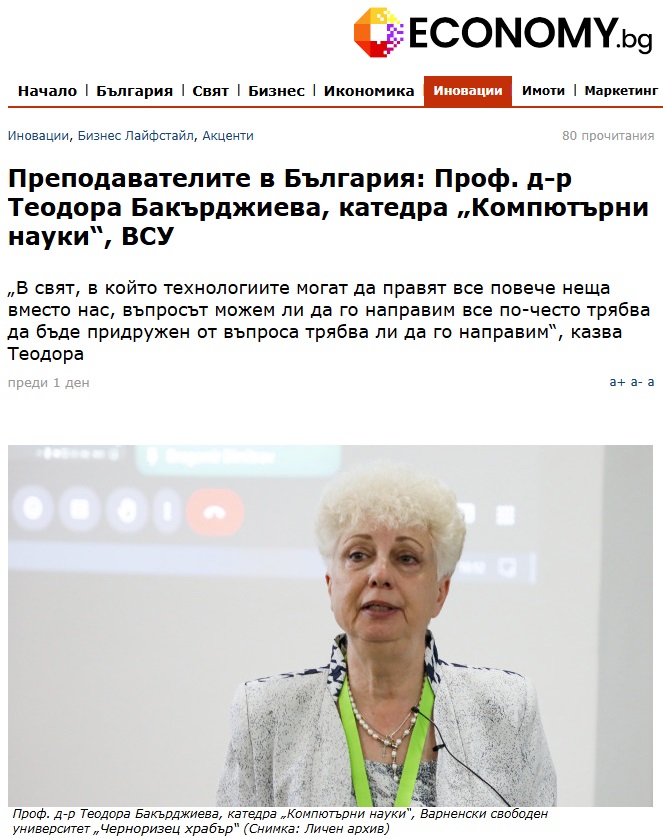
Prof. Dr. Teodora Bakardzhieva to Economy.bg: As Technology Enables Us to Do More and More, We Must Ask Not Only “Can We?” but Also “Should We?”
30 october 2026
 In its “Educators in Bulgaria” series, Economy.bg features faculty members from key universities in Bulgaria. The series traces their professional journeys, from their first steps to the lessons they have learned along the way. How do they overcome challenges? Which stories about their students make them proud? And how do they envision the future they help shape every day through their work?
Meet Prof. Dr. Teodora Bakardzhieva, Head of the Master’s degree programme in Cybersecurity, Department of Computer Science, Varna Free University “Chernorizets Hrabar.”
Please introduce yourself and briefly tell us about your education and the subjects you teach today.
I graduated from the English Language School and the Technical University in Varna, and later completed a PhD at Sofia University in the field of automated information systems. I have been working with computer technologies since the early 1990s - a period when Bulgaria was beginning to connect to the global Internet.
For more than 30 years, I have been part of the Department of Computer Science at Varna Free University “Chernorizets Hrabar”, where I teach specialized courses in cybersecurity and e-business. I am also actively involved in the development and management of international educational and research projects funded through programmes such as Erasmus+ KA2, INTERREG and Horizon Europe. I was able to apply this experience in my role as Vice-Rector for International Affairs, Projects and Technological Development.
I currently teach two Master’s degree programmes -“International Business Project Management” and “Cybersecurity”- which attract many international students and generate strong interest thanks to their practical approach to learning.
In recent years, I have also taught IT security and data protection in healthcare, as well as IoT in healthcare, at the Medical University of Varna, as part of the Master’s degree programme “Electronic and Information Technologies in Healthcare.”
At present, I am also Vice-Chairperson of the Union of Scientists in Bulgaria.
How and why did you choose a career in education?
My parents devoted their lives to education, and I wanted to follow in their footsteps. I enjoy challenges and am constantly seeking out new things, the unexplored and the fascinating – qualities that are essential to the learning process. This led me to introduce the first lecture courses in internet technologies in Bulgaria in the early 1990s.
Later, as interdisciplinary research began to permeate every area of economic and social life, I focused increasingly on this field, turning my attention to the application of IT technologies in healthcare and medicine.
How would you describe today’s students?
My long experience in teaching has shown me that students are a mirror in which we, as lecturers, should see ourselves reflected. Today’s students are much better prepared and informed, as we are constantly inundated with information through a wide range of channels. Students do not need to be mere “repositories” of information. What matters far more is their ability to think critically, ask the right questions, recognise reliable sources, analyse information, and make connections between different areas of knowledge. In this respect, the role of the lecturer is becoming increasingly important.
Do you notice any differences between today’s students and previous generations?
Of course. There are differences, as today’s students live and study in a completely different information environment. They are accustomed to accessing information quickly, working with several sources simultaneously, and expecting much more dynamic interaction. This also changes the way they learn. They find long periods of passive listening more difficult to engage with, but are highly active when they see the practical value of a task, as a pragmatic approach is a defining characteristic of their learning.
I regard this as a positive trend. A university should not produce people who merely reproduce information, but rather individuals who can question it, verify it, and develop new solutions.
What does one of your lectures look like? Has your teaching style changed throughout your professional experience?
My teaching style has changed tremendously over the years. At the beginning of my academic career, a lecture was primarily a way of transmitting knowledge. Today, knowledge is everywhere and can be accessed within seconds.
For me, a good teacher inspires students to think and to ask meaningful questions. I usually begin with a real-world problem or situation. I then explore the theoretical aspects, but always connect them to practice - whether through a specific business case, a cybersecurity incident, a new technology, an application of artificial intelligence, or a challenge faced by a real organization.
My lectures are interactive and often take the form of discussions. I use short practical cases, case studies and project-based assignments. Especially in Master’s degree programmes, it is important to me that students are not merely passive listeners, but active participants in the process of creating knowledge.
What are the biggest challenges facing teachers today?
Paradoxically, some of the biggest challenges are no longer the lack of information or the difficulty of finding it, but rather the overwhelming amount of information available and the question of its reliability.
Teachers need to help students distinguish information from knowledge, knowledge from competence, and a convincing-sounding answer from a trustworthy one. Artificial intelligence is transforming this environment even further. If a task can be completed by AI in twenty seconds, we need to ask ourselves whether it is the right task for students in the first place.
In my view, one of the major challenges facing higher education is the transition from reproducing information to developing analytical and critical thinking, creativity, responsibility, and the ability to solve real-world problems.
What skills are most valuable for being a good lecturer?
A good professional never stops developing or improving their theoretical and practical knowledge. This is particularly important in technological fields, where a lecturer who stands still very quickly begins teaching the past. Respect for the audience, the ability to explain things clearly, and maintaining continuous contact with students are all important criteria for assessing a good lecturer. A good lecturer should see the people in front of them as future colleagues and professionals from whom they themselves may one day learn.
How do you assess the level of cooperation between universities and employers in Bulgaria?
There are many very good examples, and I certainly see positive development, but the potential is considerably greater. At our university, there is a strong relationship with companies in the sector. Businesses are involved from the outset in defining the required competences, developing curricula and practical case studies, participating in the assessment of undergraduate and Master’s theses, and delivering masterclasses.
Naturally, the aim is for university education to prepare students for the real professional environment. On the other hand, however, a university should not simply follow the immediate needs of the labour market.
Our task is a longer-term one: to prepare people who can adapt to professions and technologies that do not yet even exist.
How can the relationship between business and education be improved?
Through more joint work and less formal partnership. I would like to see more real-life company projects that students work on as part of their studies; more industry professionals taking part in the learning process; more lecturers working on real business and technology projects; and more joint laboratories, research, and innovation initiatives.
The best model is one in which students understand, while still studying, how knowledge acquired in the classroom can be transformed into a solution to a real-world problem.
Do you personally use artificial intelligence, and if so, what do you use it for?
Yes, of course. It would be difficult for someone who teaches technology and e-business to talk about the transformation brought about by artificial intelligence without actively using it themselves.
I use AI as a tool for generating ideas, structuring information, analysis, comparing different perspectives, working with texts, and preparing teaching materials. I always tell my students something very important: artificial intelligence can be an exceptionally good assistant, but it must never become a substitute for independent thinking. The more powerful these tools become, the more important human abilities such as asking the right questions, checking results, and taking responsibility for our decisions become.
In your opinion, how can artificial intelligence be useful to students?
Its potential is enormous. AI can act as a personal tutor, a discussion partner, an assistant in learning foreign languages, a tool for simulations and analysis, a programming aid, or a way for students to receive immediate feedback. There is a huge difference between AI helping a student learn something and relieving them of the need to think.
If students use artificial intelligence merely to obtain ready-made answers, they may save time, but they lose out on education. If, however, they use it to ask better questions, test hypotheses, explore alternatives, and understand complex concepts, AI can genuinely accelerate the learning process. A balanced approach is essential: AI technologies should support, not replace, the lecturer. Clear policies and ethical standards for AI must be introduced and observed at every educational institution.
What do you think is needed to prepare students for the professions of the future?
In my view, we must stop preparing students solely for specific jobs. The labour market is changing too quickly. We need to prepare them to be lifelong learners, work with technology, think critically, communicate effectively, and collaborate with people from different professional and cultural backgrounds.
Technical skills are important, but they have an increasingly short “shelf life”. The ability to adapt, analyse a new problem, and learn something new is what endures.
I would add one more thing: ethics and responsibility. In a world where technology can do more and more things on our behalf, the question of whether we can do something should increasingly be accompanied by the question of whether we should.
Do you have a favourite story about students you are particularly proud of, or a story about students who have gone on to achieve success?
After more than 30 years of teaching, I have many such stories, and it is difficult to choose just one. The greatest satisfaction for a lecturer comes when they meet a former student and realise that they are no longer speaking to them as a lecturer speaks to a student, but as a fellow professional who has gone on to achieve success.
One of many examples is David Mavrodiev, a graduate of Varna Free University “Chernorizets Hrabar”, who is now a software engineer at Microsoft and holds a Master’s degree in Robotics and Artificial Intelligence from University College London. He is the youngest member of the CoreAI team and the first Bulgarian to join it.
I am particularly proud when my students establish themselves in highly competitive international environments, set up their own companies, lead teams, or return to the university as experts to share their experience with the next generation. That is when you see the true meaning of the teaching profession: knowledge does not remain in the lecture hall; it continues to live on through people.
How do you like to spend your free time?
I do not have much free time, so I value it all the more. Spending time with my children and grandchildren is what gives me the most energy. My family is my way of reconnecting with the things that matter most and are most genuine in life. I also enjoy travelling, discovering new places, and meeting people from different cultures.
See also:
Assoc. Prof. Dr. Eleonora Tankova for Economy.bg: “I Dreamed of Being Where Change Happens. It Turned Out That the University Is Exactly Such a Place”
Prof. Dr. Emil Panushev for Economy.bg: “Education Should Foster Critical Thinking and Responsibility”