

WHAT ARE THE LEGAL CHALLENGES IN CONTRACTS WITH INFLUENCERS AND BRAND AMBASSADORS?
01 july 2026
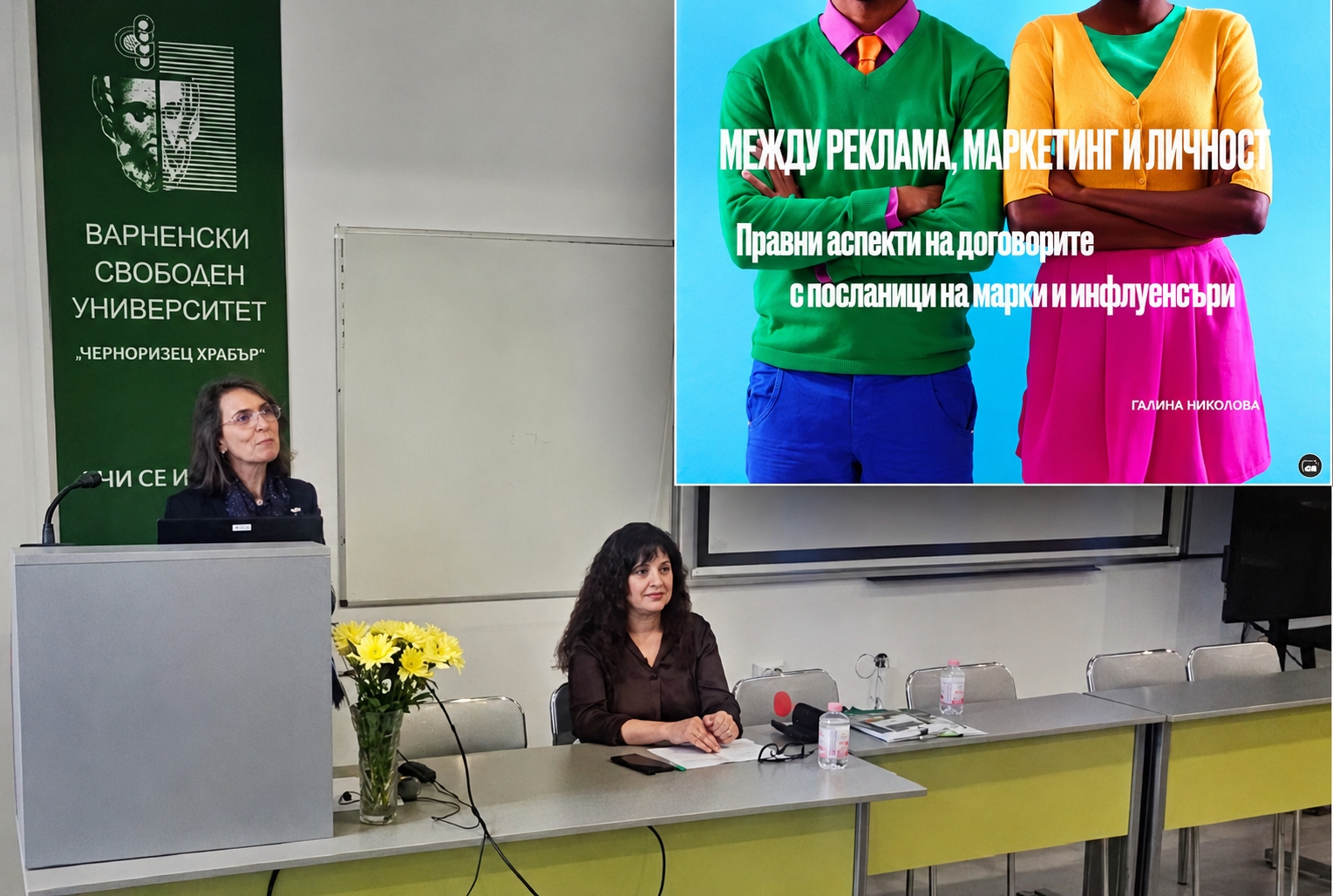
A topical analysis of this subject was presented by Sen. Asst. Prof. Galina Nikolova, PhD during the Scientific Conference with international participation entitled Law: Theory and Practice, which was held at Varna Free University "Chernorizets Hrabar" at the end of last week. The report attracted the attention of the participants with its focus on legal relations arising in the field of digital marketing and social networks.
Sen. Asst. Prof. Galina Nikolova, PhD presented the topic "Between Advertising, Marketing and Personality - Legal Aspects of Contracts with Brand Ambassadors and Influencers", which examined the growing impact of social networks on consumer behaviour, the role of personalities with a high degree of public influence, as well as the entry of virtual influencers generated with artificial intelligence. The emphasis was on the challenges facing the regulation of these public relations in the absence of special regulations. The issues related to the transparency of content, the protection of personality and brand reputation, exclusivity clauses, liability between the parties to the contracts and towards third parties, security, as well as a number of other legal and ethical aspects were analysed.
According to the analysis, the development of influencer marketing and the penetration of modern technologies outline new requirements for contractual relations and require their transformation together with the changing digital environment.
Sen. Asst. Prof. Galina Nikolova, PhD is a lecturer at the Faculty of Law of Varna Free University, a doctor of civil law and a graduate of the university. She participates in the activities of the Faculty's Law Clinic, is an academic mentor in the MES project Student Practices - from Education to Employment and is the author of scientific articles and studies in the field of contract law.
Within the framework of the Summer Scientific Session of the Faculty of Law, over 50 scientific reports were presented by scientists, doctoral candidates and students from Bulgaria, Kazakhstan, Kosovo, Poland, Romania and Ukraine. The foreign participants are representatives of the University of the National Commission for Education - Krakow, Spiru Haret University - Bucharest, Institute for Legal Studies at the Romanian Academy, AAV College - Pristina, National Law University "Yaroslav Mudryi" - Kharkiv, Institute for the Study of Crime Problems at the National Academy of Legal Sciences of Ukraine, International Tarazky Innovative Institute, etc.